
How Do You Set Up a Comfortable Rabbit Space in a Small Home?
Start with enough permanent living space: RWAF recommends a single area of at least 3 m × 2 m, with an enclosure height of at least 1 m, for two average-sized rabbits, accessible at all times. Use a secure pen or rabbit-proofed room with non-slip flooring, hiding places, hay, water and litter trays, leaving a clear area for running and resting.
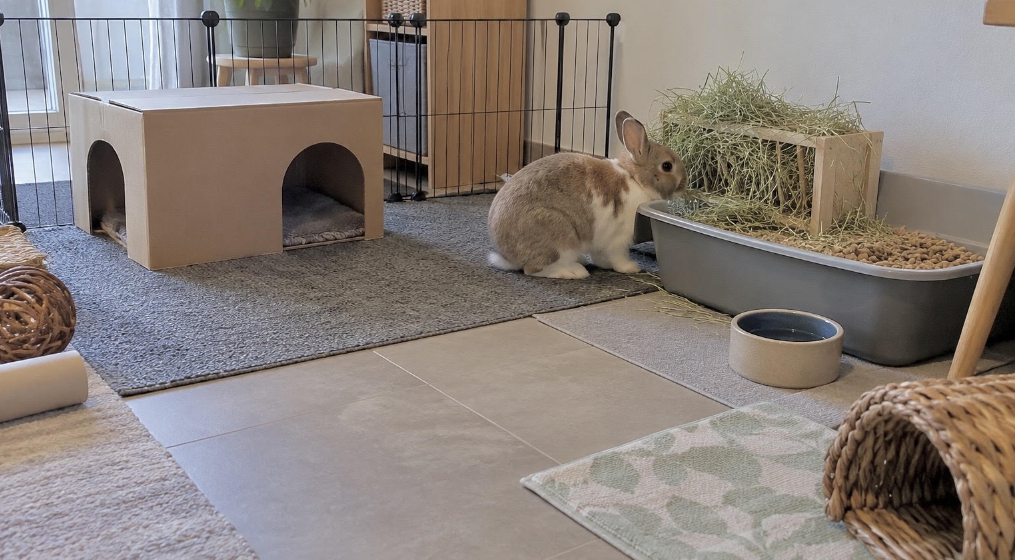
Image: AndyB
Key points
- A small cage or hutch is not suitable as a rabbit's main home.
- Rabbit welfare guidance recommends one continuous area of at least 3 m by 2 m and 1 m high for two average-sized rabbits, available all the time.
- Use solid, non-slip flooring and provide more than one hiding place.
- Plan the litter and hay area together, but keep water easy to reach and refresh.
- Cables, plants and chewable household materials need careful rabbit-proofing.
Measure the permanent footprint first
Before buying pens, beds or storage, measure a single usable area at least 3 m long by 2 m wide and 1 m high for two average-sized rabbits. Platforms and tunnels are useful additions, but they do not replace the continuous floor area rabbits need for running and normal movement.
If your home cannot provide that permanent area, pause before bringing rabbits home and ask a rabbit welfare organisation or rescue for advice. A compact home should not mean reducing the rabbits' basic living space.
Choose a quiet, safe part of the room
A calm part of a living room can work well because the rabbits remain part of everyday family life. Avoid places with strong heat, direct sun, draughts or constant foot traffic. Block access to doors, balconies and gaps behind appliances.
Use a sturdy pen or secure room barrier rather than relying on a small commercial cage. Check every join and opening from a rabbit's height.
Give the floor grip
Smooth floors can be difficult for rabbits. Cover the living area with a secure, non-slip surface that lies flat and cannot bunch under their feet. Add a soft resting area, while watching whether your rabbits chew the material.
Avoid wire flooring. Replace damaged mats or bedding before loose pieces can be swallowed.
Arrange practical zones
Keep the layout simple and leave the longest possible clear route for movement.
Litter and hay
Put a large litter tray where the rabbits naturally choose to toilet. Hay should be freely available, and placing it safely at or beside the litter tray often works with rabbits' natural habit of eating while using the tray. Rabbit Welfare Association & Fund advises against sawdust and clumping cat litter.
Water and food
Use a stable water bowl in an easy-to-reach position where it is less likely to be filled with litter or hay. Leave enough room for both rabbits to reach important resources without being crowded.
Resting and hiding
Provide rabbit-safe tunnels, chew toys and opportunities to forage. A sturdy digging box filled with hay can offer an indoor digging activity. Rotate simple activities, remove damaged items and keep the main running area clear.
Rabbit-proof beyond the pen
Rabbits explore by chewing. Keep electrical cables completely out of reach, protect skirting boards and furniture, and remove toxic or unidentified houseplants from accessible areas. Keep medicines, cleaning products and small objects securely out of reach.
Recheck the area after moving furniture. A new narrow gap can become an unsafe hiding place.
Keep care items close without taking rabbit space
Store hay, litter, a brush and cleaning tools just outside the enclosure in one lidded box or narrow cupboard. Do not use the rabbits' floor area for bulky storage. Keep hay dry and make sure stored items cannot fall into the pen.
Use a short daily check
Each day:
- refresh water and make sure hay is available;
- remove wet or dirty litter as needed;
- check flooring, barriers, cables and toys for damage;
- confirm that both rabbits are eating, moving and behaving normally.
A tidy layout makes these checks easier, but it should never come at the cost of space, companionship or opportunities to hide and move.
Further reading: - Rabbit Welfare Association & Fund — Indoor rabbit housing, https://rabbitwelfare.co.uk/welfare-need/indoor-rabbit-housing/
- Rabbit Welfare Association & Fund — Space recommendations, https://rabbitwelfare.co.uk/welfare-need/space-recommendations/
- Rabbit Welfare Association & Fund — Bedding and litter, https://rabbitwelfare.co.uk/welfare-need/bedding-and-litter/
- Rabbit Welfare Association & Fund — Hiding, https://rabbitwelfare.co.uk/welfare-need/hiding/
Sources and further reading
- Rabbit Welfare Association & Fund — Indoor rabbit housing
- Rabbit Welfare Association & Fund — Space recommendations
- Rabbit Welfare Association & Fund — Bedding and litter
- Rabbit Welfare Association & Fund — Hiding
This practical tip is general information, not veterinary advice. For anything specific to your animal, please speak to a qualified vet.